1 min read
A Comprehensive Guide to AI Search Content Optimization
Creating content that thrives in an AI-driven search landscape requires a strategic blend of SEO optimization fundamentals and new approaches...
10 min read
What We Learned in 2025 and How To Move Forward
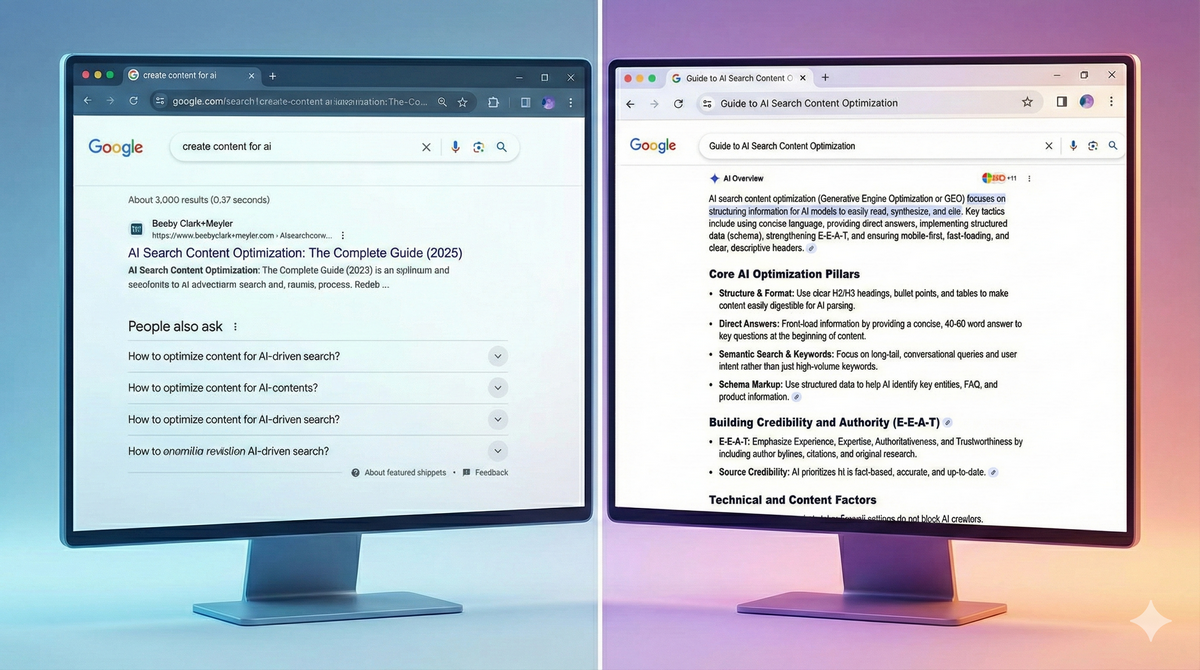
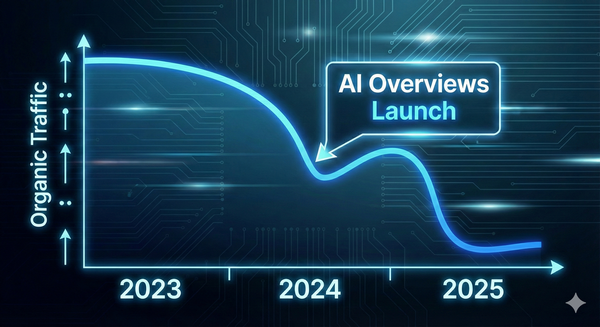
In 2025, we all watched our organic traffic charts go reverse hockey stick. AI Overviews had arrived, and Google was answering questions before anyone could click. Panic set in across marketing departments everywhere. We had our collective WTF! moment and decided that this time, finally, SEO was really dead. The conferences filled with doom. LinkedIn exploded with hot takes. Agencies scrambled to rebrand their services. Some SEOs quietly updated their resumes.
Wrong. Again.
Look, we've all read the "SEO is dead" takes. They've been written, debated, and buried more times than we can count. So let's not rehash that argument. Let's acknowledge what's actually true: if your definition of SEO is "optimizing for Google Search to drive website clicks," then yes, that specific motion is becoming less effective as a standalone growth strategy. Zero-click searches now account for over half of all queries. AI Overviews are answering questions before users ever see your blue link. That's real.
But here's what's also real: SEO as content marketing has never been more alive.
For years, we've been calling it "SEO" when what we really meant was "creating valuable content that answers questions and builds authority." The Google ranking was just the distribution mechanism. The content was always the product AND the media.
Good content marketers have always understood something that pure SEO tacticians missed: the detach-and-distribute model. Your website is home base, but your content needs to live everywhere your audience lives. This used to be about earning backlinks. Now it's about presence.
Think about TikTok. When you create content for TikTok, you're not doing it so someone searches Google, finds your video, clicks through, and visits your website. You're doing it because that's where discovery happens. The same logic now applies to AI search. Your content needs to be good enough that AI systems cite it, quote it, and surface it. Not so users click through to your site, but so your brand becomes the trusted answer wherever the question is asked.
This is the shift. From the off-site perspective, Links used to be the goal because links drove rankings which drove clicks. Now, presence and visibility is the goal. Being cited in an AI Overview. Being quoted in a ChatGPT response. Showing up in Perplexity's answer. Having your brand name attached to authoritative information wherever people are looking for answers.
As Lily Ray has noted, the content that "performs best in AI overviews" is the same content that was already deemed high-quality by Google's algorithm. The game didn't change. The scoreboard did. And the brands that were playing content marketing right all along are the ones winning now.
AI didn't break SEO. It exposed where SEO was running on autopilot. As Shanta Naranng observed, "SEO doesn't fail suddenly. It drifts." Traffic loss usually isn't one big algorithmic hit; it's the accumulation of many small neglects. It was glaringly different this time.
Many organizations fell into a routine of SEO by checklist. Publish content at volume. Target every keyword variant. Automate templates. Pray to the Google gods. When rankings dipped, blame the algorithm and roll out the next round of optimizations without asking whether the content was actually the best answer available.

The explosion of AI writing tools quickly made this worse. It became easy to pump out paragraphs at scale, but much of it was fluff. Brands chased volume over depth, publishing "SEO content" that said very little, very blandly. This worked (sort of) when Google's 10 blue links would deliver a few curious clicks even to mediocre pages.
But AI search doesn't play that game. When users ask an AI assistant for the answer, fluffy pages never make the cut. The AI pulls from the top authoritative sources it can find. It has no interest in your 800-word generic blog post that reads like everyone else's. In 2023 and 2024, a lot of companies learned they'd been coasting on borrowed time.
Technical discipline drifted too. Site speed, schema markup, internal linking: these are not new concerns. Yet many sites let their technical SEO lapse. That wasn't fatal when the old SERP was forgiving. But AI search is ruthless. If your content is buried in a slow or hard-to-crawl site, it might as well not exist.
In short, SEO got soft. AI didn't create this problem. It exposed it in stark terms. It removed the cushion that allowed middling practices to still yield results.
In the old Google setup, a user searches a question, sees 10 results, and clicks two or three to compare answers. A less-than-stellar page could still get a chance simply by ranking in the mix. The buffer for error was large. Even mediocre content got pageviews from curious clickers.
AI-driven search has collapsed that process. Ask the same question in an AI-enabled search, and you get a single synthesized answer with one or two citations. The user might never see the dozens of other sources. If your content isn't one of the select sources an AI trusts, it's invisible.
As one SEO professional commented, "AI search does not change the rules of SEO. It rather takes them to the extreme. From top 10, to top 1." If you used to be anywhere below the very top result, your share of visibility may now be zero.
But here's the flip side: when brands publish exceptional, well-structured content, it gets picked up in AI answers within hours. No special trick. Just doing content marketing right. The safety net is gone, but that's forcing everyone to be better. And that's good for brands willing to put in the work.
Here's the uncomfortable truth nobody wants to hear: what's holding most brands back from SEO success isn't that SEO doesn't work. It's the misguided belief that it should be "free."
SEO was never free. It was just cheaper than paid media, and the ROI was often better. That ROI still exists today. Blue links are still driving traffic and conversions. But the window is narrowing, and the brands investing now in quality content are building assets that work in both the current landscape and the one coming next. The cost of waiting is that you'll be starting from scratch when the shift accelerates.
Creating content that can compete with the best of the internet on any given day, content that an AI will cite over millions of alternatives, takes real investment, and maybe you should be thinking about it like another paid media channel.
Think about what you're competing against. Your content isn't just up against your direct competitors. It's up against everything on the internet. Every TikTok video. Every Reddit thread. Every Wikipedia article. Every industry publication. The AI is scanning all of it and choosing the best answer.
That level of quality takes money. It takes planning. It takes testing. It takes a willingness to try things that don't work and learn from them. It takes hiring actual experts or paying for access to proprietary data. It takes design resources to make content visually compelling. It takes distribution strategy to get content in front of audiences wherever they are.
The brands winning right now aren't the ones with the biggest content teams. They're the ones treating SEO and content like a marketing tactic with a real budget, real quality standards, and real accountability. They're investing in original research, unique data, expert perspectives: things that only they can bring to the table.
As Google's Quality Rater Guidelines make clear, unoriginal or low-effort content is explicitly flagged as low quality. That includes auto-generated fluff with no added insight. In the age of AI, pumping out cheap content is like paying to be ignored.
If your organization isn't willing to invest in content at this level, you're not playing the same game as the brands that are winning. And that's a strategy conversation, not an SEO problem.
If AI search has exposed your weaknesses, the answer isn't a new gimmick. It's fixing the fundamentals. As Danny Sullivan put it, "good SEO is really the same thing as good GEO." The same ranking signals and quality criteria that Google has always used also determine what gets pulled into AI answers. Do good SEO. Give it as much attention as you give your paid media.
It starts with truly understanding what your target user is asking and why. Put aside keyword checklists and dig into intent. What problems are they solving? What follow-up questions do they have? Build content that comprehensively answers those needs.
Generative AI tends to fan out into multiple sub-questions, so your content should cover the full conversation. Lead with the answer upfront, then provide depth. The goal of your content is to be so thorough that any and every question your audience has in relation to your content topic gets answered. That is when an AI considering sources can't ignore you.
E-E-A-T (Experience, Expertise, Authoritativeness, Trustworthiness) matters more than ever. High-quality, factual, trustworthy content is non-negotiable. Generative AI is trained to avoid bad info. The content that gets featured has strong credibility signals.
Feature real experts in your content. Make sure author names and bios are present whenever possible. Highlight actual experience. Those trust signals increase the likelihood an AI will deem you credible. AI systems are also pulling from Wikipedia, Reddit, Stack Exchange, and other public sources. Being cited there, or at least having consistent facts that match, helps.
Ensure your site is technically solid. Technical SEO is foundational. Fix crawl errors, improve site speed, use proper HTML semantics. Clear structure helps Google rank you and helps LLMs extract key points accurately.
Use schema markup to indicate important details. Generative search is an extension of rich results and featured snippets. Many tactics like FAQ sections and clear subheadings make it easy for AI to grab your content as a concise answer.
Don't neglect site hygiene: update sitemaps, ensure HTTPS is in order, prune dead-weight pages. Well-maintained sites get prioritized. If Google can't crawl or trust your site, nothing else matters.
Foster collaboration across your marketing teams. SEO can't live in a silo. Your PR, social, content, and SEO efforts all feed into the signals that AI and search pick up. A strong social discussion about your content could boost its perceived authority. Being cited in third-party articles or present in relevant forums increases your footprint.
Think about where your audience discovers information and make sure you're there. Not to drive clicks back to your site, but to build presence and authority wherever questions are being asked. This is content marketing's detach-and-distribute model, and it's never been more important.
Discipline means continuous learning. The past two years humbled a lot of people. But don't confuse adaptation with chasing every shiny object. Stay informed, test smartly, and don't throw out your playbook for every trend.
Keep an eye on Google's guidelines as they relate to AI. Google has confirmed that experience and trust signals remain key even for AI-generated content. Often the answer from Google is "just make good content." But if there are specific technical recommendations, implement them.
This is the question everyone is asking: if website traffic from search is declining, how do we measure whether our content strategy is working? It's a fair question, and it requires rethinking what success looks like.
First and foremost, Google's blue links aren't dead yet. But you've seen the numbers, and any trend line will show you where they're headed. AI Overviews appear in roughly 60% of searches today for some categories, and that number climbs to 74% for longer, problem-solving queries. The trajectory is clear, even if the timeline isn't.
Before anything else, you’ll need to educate your C-suite that the measurement model is changing. Traditional traffic metrics may decline even as your content's reach and influence grow. This is a tricky conversation, but necessary. Frame it around brand authority and market presence, not just clicks. The brands winning in AI search aren't measuring success the old way. Neither should you.
So the smart play is to do both: optimize for today's blue links while building the presence and authority that will matter when those links become footnotes and measure it from both sides. Don't abandon traditional SEO metrics. They still matter and will for some time. But start layering in the new measurements now, before you're forced to.
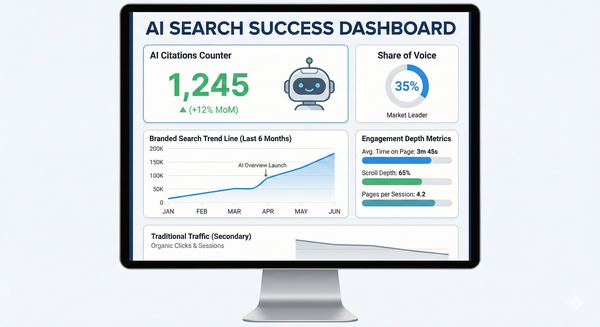
First, track AI visibility directly. Monitor if and when your pages are getting cited in AI Overviews, Bing Chat, Perplexity, or ChatGPT responses. This might involve manual checking or third-party tools that track AI citations. Some platforms are emerging specifically to monitor brand mentions in AI-generated answers. If you're being cited as the source in AI responses, that's visibility, even without a click.
Second, watch your branded search volume. Users who encounter your brand in an AI answer may not click through immediately, but they often search your brand name later. If your branded search queries are increasing even as organic traffic from non-branded queries decreases, that's a signal your content is building awareness. Google Search Console and your analytics platform can help you track this.
Third, measure Share of Voice in your category. How often does your brand appear when key questions in your industry are asked? This can be measured by sampling queries in AI tools and traditional search, then tracking how often you appear versus competitors. Some tools automate this, but even manual sampling gives directional insight.
Fourth, track referral traffic from AI sources. Some AI platforms do provide direct links. Watch your referral traffic for sources like Perplexity, Bing (which powers ChatGPT's Browse feature), and other AI assistants. As these platforms evolve, they may become meaningful traffic sources. You want to know if they're sending visits and how those visitors behave compared to other channels.
Fifth, look at impressions in Google Search Console, not just clicks. If impressions are rising while clicks are dropping, you're experiencing the "AI overview effect." Your content is being seen, just not clicked. This isn't necessarily failure. It may mean your brand is getting exposure in AI-generated summaries. The question becomes: how do you convert that visibility into downstream action?
Sixth, track downstream conversions more holistically. Users who first encounter your brand in an AI answer might convert later through a different channel. They might visit your site directly, follow you on social, or remember your brand when they're ready to buy. Multi-touch attribution becomes more important. Consider surveying new customers about how they first heard of you.
Seventh, measure content engagement, not just traffic. When users do click through, are they engaging deeply? Time on page, scroll depth, pages per session, and conversion rate all matter more when volume is lower. A smaller number of highly engaged visitors can be more valuable than a larger number who bounce.
Despite all the hand-wringing, SEO is very much alive going into 2026 and beyond. What died is the narrow definition of SEO as "optimize for Google clicks." What's thriving is SEO as content marketing: creating valuable, authoritative content and distributing it wherever your audience discovers information.
SEO did not die, and Google did not fail us. Publishers failed when they lost focus. AI search didn't break the game, but it rewrote the scoreboard. Now, only the best content wins the visibility that used to be spread across a dozen okay results.
You don't need a new playbook. You need to remember what made content marketing powerful in the first place: delivering the most helpful answer to the user, wherever they're asking the question. That's it. Every algorithm tweak Google has made, every AI model deployed, is striving to reward that.
As one industry panelist summed up: "You win AI search by continuing to implement solid SEO practices." The future of search is here, and it's demanding excellence. For those willing to invest in quality, it's full of opportunity.
SEO isn't over. The companies that embrace content marketing discipline won't just survive in the age of AI search. They'll dominate it.

1 min read
Creating content that thrives in an AI-driven search landscape requires a strategic blend of SEO optimization fundamentals and new approaches...

1 min read
If you haven't yet, pause and check out ourComprehensive Guide to Content Optimization for AI Search. This part isn’t rocket science…Your content is...
Last week we talked about the value of having SEO and Copywriters work together to craft SEO optimized copy, this week we’ll dive deeper into the SEO...