AI Search Did Not Break SEO. It Exposed It.
AI Overviews didn't kill SEO—they exposed where it was running on autopilot. Learn why SEO as content marketing is thriving and how to adapt your...
5 min read
When we first made this argument, the case rested on volume. Organic drove the largest share of website traffic, ranking well meant clicks, and clicks meant growth. That was a reasonable case to make at the time.
It isn’t the case anymore, and pretending otherwise would waste your time.
Google’s AI Overviews now appear on roughly 48% of tracked queries, up from about 30% a year earlier (BrightEdge, February 2026). When one appears, people click a traditional result about 8% of the time, against 15% when there’s no summary. They click a link inside the summary itself roughly 1% of the time (Pew Research Center, July 2025, based on browsing data from 900 US adults across about 69,000 queries in March 2025; Google has publicly disputed the methodology and sample size).
So if you came here looking for reassurance that rankings still deliver traffic the way they did three years ago, we don’t have it.
What we do have is a better argument for investing, and it’s built on something sturdier than session counts.
People are still searching. They’re searching more, and with longer, more conversational queries. What changed is that a growing share of those searches resolve on the results page or inside a chat window, without anyone landing on a website.
Session count stops being a performance metric at that point and becomes a measure of how often Google chose to send someone, which is not a thing you control.
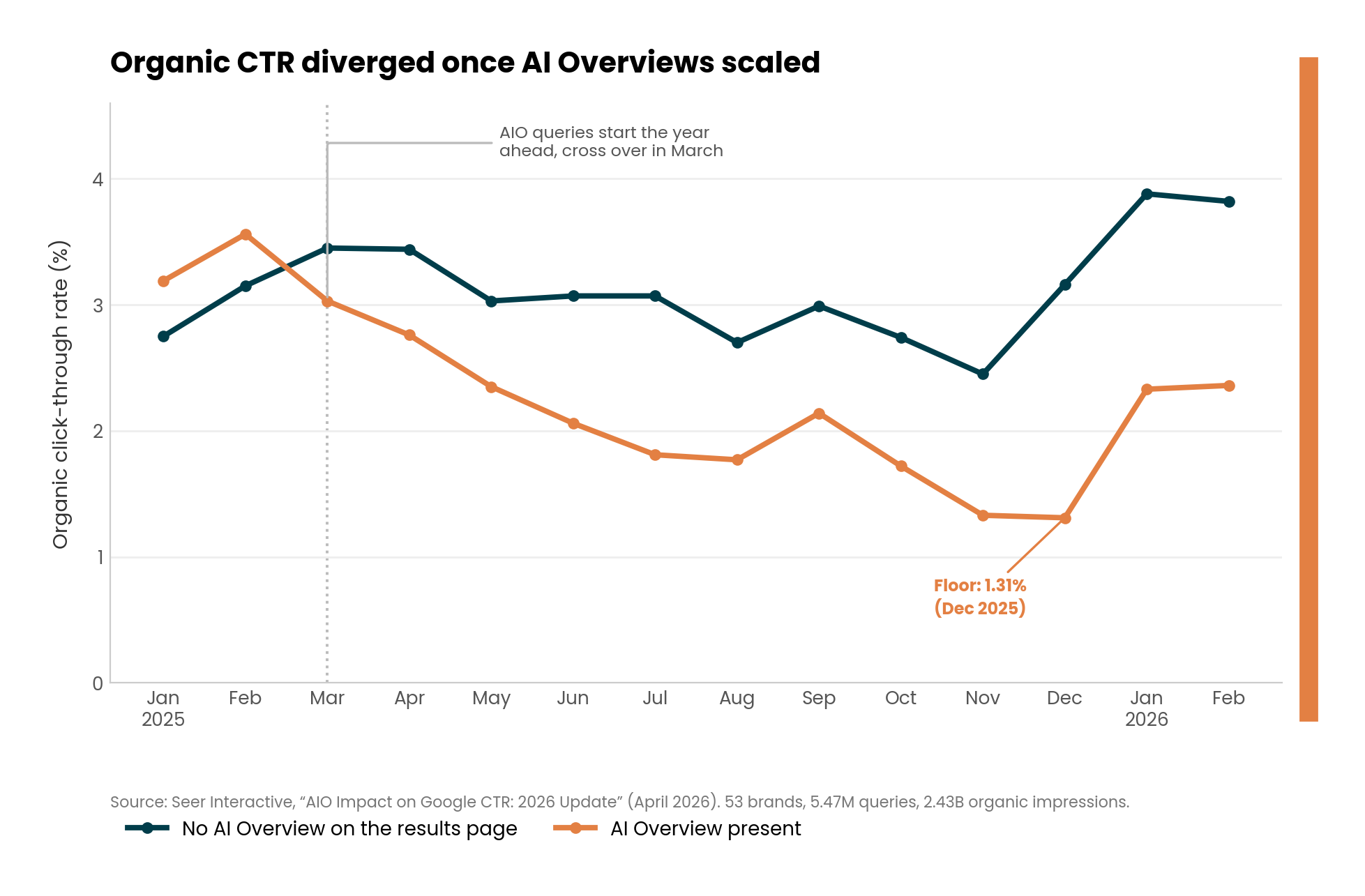
There’s also a recovery worth knowing about. Seer Interactive tracked 53 brands, 5.47 million queries and 2.43 billion impressions between January 2025 and February 2026. Click-through rate on AI Overview queries bottomed out at 1.3% in December 2025, then climbed to 2.4% by February 2026. Over the same period, CTR on queries without an AI Overview rose from 2.8% to 3.8% (Seer Interactive, 2026).
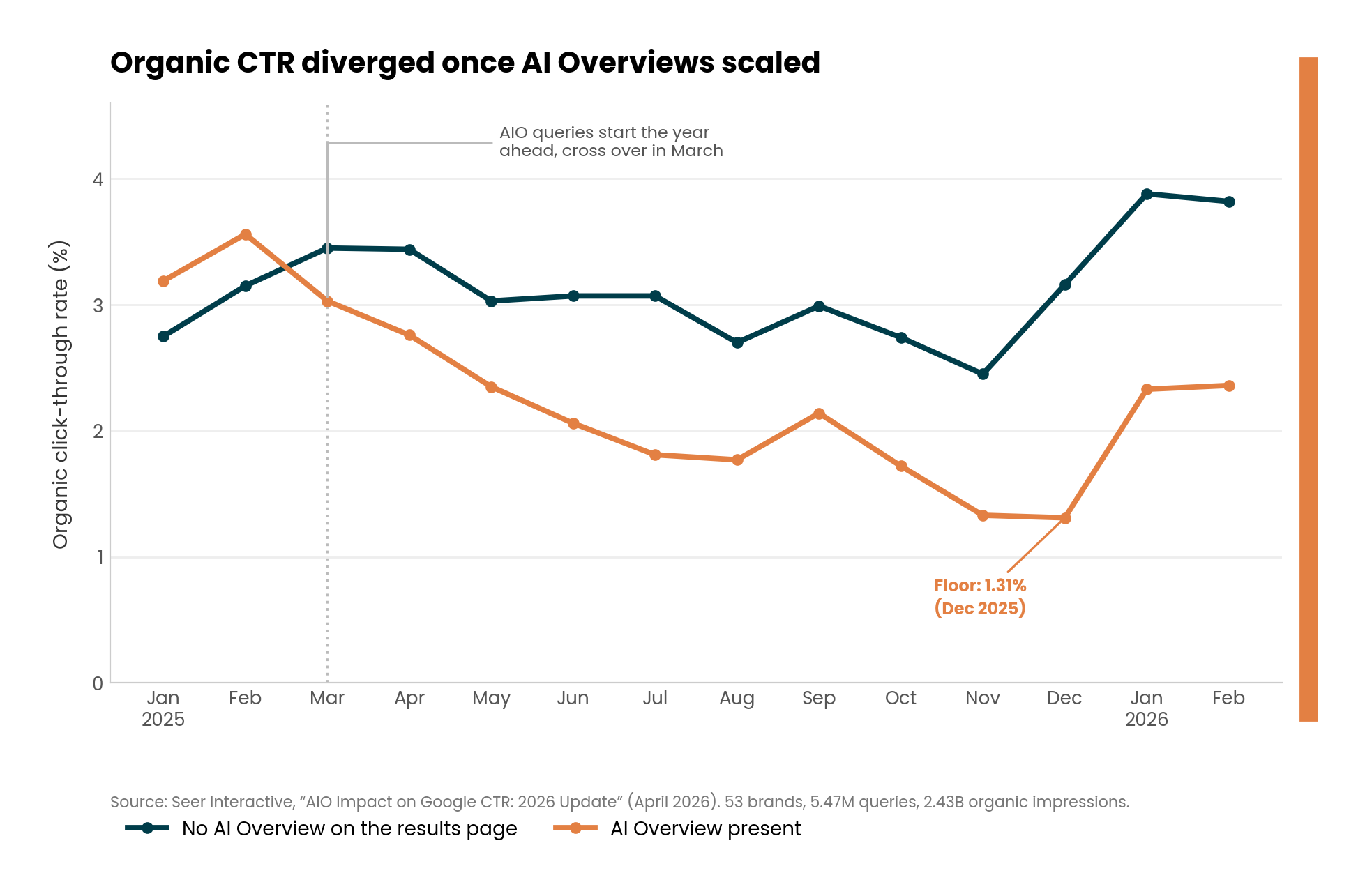
The two lines only separate in March 2025. Before that, queries showing an AI Overview were converting attention slightly better than queries without one.
Two things follow from that. Searches without an AI Overview are getting more valuable, not less, and roughly half of all queries still don’t trigger one. The other half is where being cited becomes the job.
BrightEdge reports that only about 17% of sources cited in AI Overviews also rank in the organic top ten for that query. Read alone, that sounds like rankings stopped mattering. But the same research shows that citations overlapping with pages ranked anywhere in the top 100 grew from 32.3% in May 2024 to 54.5% by September 2025 (BrightEdge).
Both are true. Google increasingly pulls from content it already trusts enough to rank, and it deliberately reaches past position ten to do it. Being indexed, crawlable and ranked somewhere credible is now the qualifying round. Winning position one for a keyword doesn’t win you the citation for that keyword.
This is genuinely good news if you’ve been outspent on the head terms for years. The thing that used to lock you out, not having the authority to crack the top three against a national competitor, matters less than it did. What gets you cited is answering a specific question clearly, in a structure a model can extract, on a page it can reach.
The gap between earning that citation and not earning it is wide enough to justify the work on its own. Seer put it in click terms: for every million organic impressions on informational queries, a page with no AI Overview above it earns roughly 33,500 clicks, a page cited inside the AI Overview earns about 20,700, and a page sitting on that same results page without a citation earns about 9,400. Being cited roughly doubles what you get against the uncited competition on the identical SERP. It still leaves you well short of where that query would have sent you before the summary existed, which is the part nobody selling AI search services tends to mention.
Our guide to AI search content optimization covers the mechanics of that in detail, and the off-page side covers the entity, citation and mention work that sits outside your own domain.
The visits that survive the AI answer behave differently. Semrush found AI-referred visitors converting at about 4.4 times the rate of traditional organic visitors (Semrush, “We Studied the Impact of AI Search on SEO Traffic,” June 2025, covering more than 500 high-value topics).
Be careful with that number, and with the more dramatic versions of it circulating. AI referrals currently make up around 1.08% of total traffic across the industries Conductor studied, with ChatGPT accounting for roughly 87% of it. When the denominator is that small, conversion percentages move a lot on small absolute changes, and published studies define “conversion” inconsistently. Treat the direction as reliable and the multiple as approximate.
Someone arriving from an AI answer has already had their question answered, already seen you named as a credible source, and is further along than someone clicking a blue link at the start of a research process. You’re being introduced rather than discovered.
The original version of this argument said SEO levels the playing field against bigger competitors. That was half right then and it’s more right now, for a different reason.
Paid media costs keep climbing and the ceiling on what budget buys hasn’t moved in your favor. Meanwhile the mechanism that used to protect incumbents, accumulated domain authority converting directly into top-three rankings, has loosened its grip on the part of the results page that increasingly gets read. If five out of six AI Overview citations come from outside page one, then page one is no longer the moat it was.
That doesn’t mean it’s easy. It means the work shifted from out-ranking to out-answering, and out-answering is a content and expertise problem rather than a budget problem. Some of you are better positioned for that than the national brand you’ve been losing to, because you actually know the answer.
If your reporting still equates organic sessions with marketing performance, it will tell you things are getting worse every quarter regardless of what you do.
Replace it with a smaller set that reflects how discovery actually works: citation share across the AI platforms your buyers use, branded search volume as a downstream signal that people encountered you somewhere, conversion rate and revenue per visit segmented by source, and impressions alongside clicks so you can tell the difference between losing visibility and losing the click.
That last one matters more than it sounds. Seer flagged their single biggest monthly CTR drop of the year, a 52% fall in October 2025, and then found clicks had actually held steady at around 400,000 while impressions doubled from 15.8 million to 33.1 million. The brands in that cohort were earning citations on more queries, not losing clicks. A CTR chart alone would have told the opposite story.
Google Search Console now breaks out AI-surface data, which helps. Most of the rest requires tooling that didn’t exist three years ago. We wrote about what we’ve learned running this in practice, including where the measurement is still directional rather than precise.
This can be done in-house, and some teams should. What’s changed is the surface area. You’re now maintaining content quality, technical crawlability for a new class of agents, entity and citation presence across platforms you don’t control, and a measurement stack that’s still being invented. That’s more moving parts than it was, and the tooling costs real money before anyone writes a word.
What an agency buys you is the tooling already paid for, the pattern recognition from watching this play out across multiple industries at once, and cross-team visibility if the same group handles your paid search and organic. We manage both, which means the paid data informs the organic work and neither team is guessing about the other.
If you want to see what this looks like for your business, our enterprise SEO services for AI search page has more detail, and you can get in touch for a look at where you currently stand in AI answers for the questions your buyers actually ask.

AI Overviews didn't kill SEO—they exposed where it was running on autopilot. Learn why SEO as content marketing is thriving and how to adapt your...
What changed in AI search this year, and how to build content that Google AI Overviews, AI Mode and ChatGPT will actually use.
Having a well defined SEO process is key to build long-term organic traffic. Click to learn about important elements of SEO structure and strategy.