Why Your 'Proven' Marketing Strategies Are Failing (And What Actually Works Now)
Learn why single-message campaigns, CAC obsession, and last-click metrics fail in today’s AI-driven media—and how message, funnel & signal diversity...
11 min read
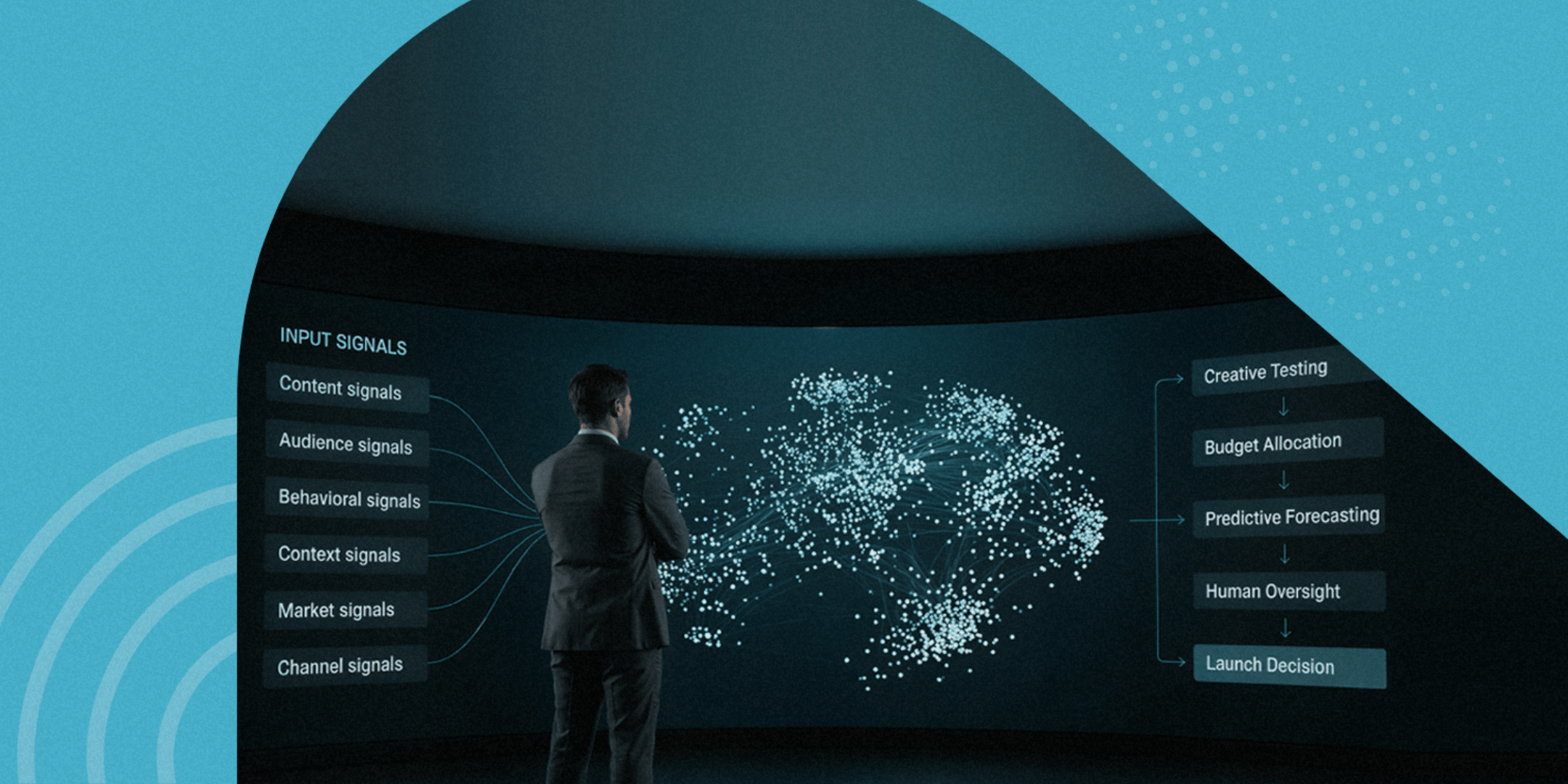
▸Key takeaways
In the late nineteenth century, as newspapers proliferated across the United States, buying advertising quickly became an operational challenge. Every publisher had different circulation figures, pricing models, publication deadlines, production requirements, contracts, artwork specifications, and mechanical standards.
National advertisers suddenly found themselves negotiating with hundreds of potential publishers, each operating differently. Managing the process internally was inefficient, expensive, and increasingly impractical. Along came “agents” to help handle ad placement and all the details associated with it.
At first, agencies were classic brokers. They understood how to navigate a fragmented media marketplace more efficiently than individual advertisers ever could and could secure better rates or placements as a result. They consolidated the buying and placement of ads. They also secured better economics behind it.
Over time, they evolved into strategic advisors, researchers, creative partners, planners, negotiators, and trusted stewards for the world's largest and most successful brands.
Every major transformation in media since has followed a somewhat similar pattern, and the old adage, often misattributed to Mark Twain, that history may not repeat itself, but it does rhyme, is worth paying attention to at a time like the one we are living in today.
Radio, TV, cable, digital. Same pattern every time.
If we look back, we can see that the emergence of radio created new specialists. Along with the radio dramas came more emotional advertising formats.
Television reshaped the agency business yet again. TV was the first true mass medium. The agencies behind it built some of the largest brands and cultural moments of their day, reshaping our entire understanding of how brands get built and reinventing society along the way.
Cable introduced another layer of complexity to the equation, splitting the mass TV audience into niche segments and introducing more measurement complexity (but also some hope via addressable households).
Then came the internet.
Search, social media, mobile, streaming television, retail media, connected TV, app marketing, and programmatic advertising each demanded new skills, new technologies, and new operating models.
But one thing has remained consistent throughout: every new medium promised to simplify advertising. Instead, every new media or technology innovation created more data, more fragmentation, more decisions, and greater complexity.
Same shape, different technology.
.webp?width=940&height=529&name=Age%20of%20Algorithmic%20Media-%20image1%20(1).webp)
And in that regard, the demand for agency-like services only increased at each turn.
Digital is a very good example and one I am familiar with. Agencies didn’t always capture the growth brought on by the expansion of digital media, and others crowded into the space, but whether it was OMD, BCG, or one of the four-letter holding company spinoffs nobody can keep straight, clients increased their use of agency-like services to help navigate the shift and manage the underlying transformations required to do so.
The agencies that thrived through each transition throughout history were those that adapted to the new media environment and developed services to support their clients’ emerging needs.
At BCM, we were around for the first transition when the internet hit advertising and made our careers by being on the right side of history. We believe we are standing at another one of those moments today. Only this time it is much bigger, and the stakes are much higher.
Every platform has an AI announcement. The shift underneath them is the real story.
For the past year, the industry has been focused on AI features in an Oprah-like sequence of announcements. Google introduced AI Mode. Meta opened its advertising infrastructure to AI agents. OpenAI entered advertising. X integrated Grok into Ads Manager. Every major platform now offers AI-generated creative, automated optimization, conversational campaign planning, or autonomous decision-making.
Those announcements matter, but they matter even more as part of a larger narrative about the changes underway than they do as individual points of significance.
Advertising has entered what I believe will come to be known as the Age of Algorithmic Media.
For most of advertising history, people decided who saw an ad, when they saw it, what creative they received, and how budgets were spent. Media planners built the plans, and media buyers executed them. Creative directors selected the messages, with input from clients, of course, and analysts reviewed results and recommended changes. Even paid search managers fiddled with keyword bids and match types.
That operating model is disappearing. In fact, in many ways it is already gone. Increasingly, algorithms determine who sees an ad, when they see it, what bid is placed, how audiences are segmented, what message comes next, and how marketing dollars are distributed.
The overwhelming majority of advertising decisions are steadily moving from people to machines. While this is not new (we have had automated, algorithmic bidding and media decisioning tools for years), the scale, efficacy, and breadth of their application are new.
So, does that mean I no longer need media buyers or creative directors? Similar to past transitions, you may need help in those areas more than ever. But not the same help, since the onset of AI does mean their jobs are changing.
Instead of making thousands of individual campaign decisions, which is not a human-scale endeavor, today’s digital media and marketing specialists are increasingly responsible for designing, supervising, validating, and governing the systems that make those decisions. Systems over individual executions.
.webp?width=940&height=529&name=Age%20of%20Algorithmic%20Media-%20image2%20(1).webp)
This is every bit as significant as the transition from traditional advertising to digital marketing. Perhaps even more so. While digital changed the ad industry, the core agency model remained more or less intact. You had account, media, creative, research, and production people in traditional agencies, and the same structure was replicated more or less in the digital agency model.
Digital changed where advertising happened. Artificial intelligence is changing how advertising happens, and that is more profound. That shift requires a fundamentally different kind of agency, and not just a simple re-skinning of the traditional model.
The winners will be built around AI. The rest will bolt it on and hope.
When digital advertising emerged twenty-five years ago, many traditional agencies viewed the internet as another media channel. Digital-first agencies understood something far more important. The internet wasn’t another channel. It introduced a completely different operating model built around data, experimentation, optimization, and continuous measurement based on a two-way feedback loop that didn’t really exist in media before then, with all due respect to my DM brothers and sisters.
Those agencies ultimately surpassed many of the industry’s traditional leaders. Today, the world's leading agency is the one that acquired my former digital agency along with many others to reinvent itself as a modern media/digital-first specialist. It has been rewarded accordingly.
Today, we see many digital agencies making the same mistake traditional ones did at the dawn of the digital age. They’re adding AI tools to an operating model to replace people who, today, manually build campaigns, manage spreadsheets, traffic creative, and assemble reports. That isn’t enough to win.
The agencies that define the next decade will be AI-native. The rest will pave the cow path from the previous structural model and wonder why it stopped working.
The new operating model is AI-native, not superimposed. The winning agencies are not automating existing services to make them cheaper or faster. They are using AI to do things the old model could not do at all.
Audience simulation, creative pre-testing, predictive forecasting. Here is what actually changes.
An AI-native agency simulates audiences before spending a single media dollar to increase their probability of success. That is not an existing service delivered at a lower cost. It is a new capability, and it opens up whole new avenues for growth. This is built into our Ventas AI system.
.webp?width=940&height=529&name=Age%20of%20Algorithmic%20Media-%20image3%20(1).webp)
They evaluate thousands of creative variations before a campaign launches and use advanced agent-based models and predictive analytics to surface the ad most likely to perform or uncover “hidden” insights imperceptible to humans through advanced pattern recognition.
The modern agency uses advanced analytics to report on what happened and why, like any agency, but they also use them to forecast what will happen based on 1000s of scenarios, helping to reduce risk and improve outcomes.
They automate repetitive tasks, so experienced strategists can spend more time helping clients solve business problems rather than managing production schedules.
An AI-native agency also knows how to build content at scale without producing garbage. We have used AI-driven workflows to do exactly that and won awards for the results. Those are the AI-native efficiencies that actually matter. Not doing the same work faster. Covering more ground, with better research behind it, and understanding how to optimize modern, algorithmic media using creative as a signal.
I have some potentially good news or bad news for you: some of those agencies already exist. I know because I work at one and have spent the last five years building it. If you aren’t working with one, you need to be asking yourself if your competitors are.
I believe the industry’s best digital agencies will evolve into AI-native agencies. Others will not. And they will struggle or go out of business.
The platforms’ AI works for the platforms. Whose AI works for you?
Ironically, the more automated advertising becomes, the more independent human judgment is worth. Experience, the ability to contextualize, and the judgment to apply that experience all still matter.
Every major platform now has AI making recommendations. Soon, if not already, those recommendations will become autonomous decisions.
Anyone seeing a pattern here? Who is making recommendations for you and your brand?
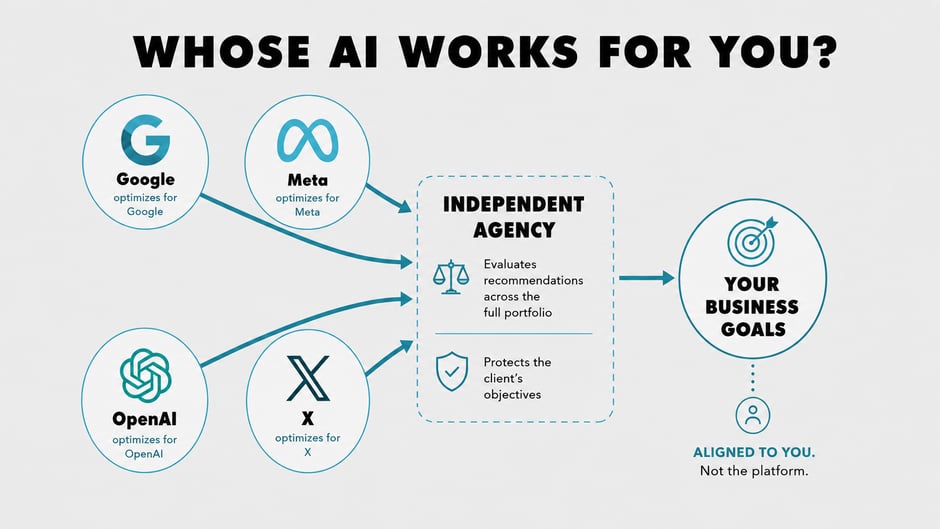
There is nothing inherently wrong with platform-side AI. Every company is expected to build products that strengthen its business, and the platforms are doing so. We can and do use some of these tools (and choose not to use others).
The truth is that advertisers have always needed someone sitting on the other side of the table whose sole responsibility is representing their interests. That has traditionally been the ad agency's role. And AI is not changing that dynamic. In the near term, it strengthens the need for such partners.
The best agencies have never bought media transactionally.
They challenged assumptions, tested competing approaches, questioned attribution models, evaluated new technologies, and translated complexity into business outcomes. Their value came from independence every bit as much as execution. At my own agency, we invented entirely new ad types and formats to deliver on a strategic creative vision for GE.
A good agency partner will tell you what you need to hear, even if you don’t want to hear it. A quote from a friend of mine from a chewing gum client pitch sums this truth up. They had conducted consumer research and were presenting the findings. He opened the meeting by saying:
“Your gum sucks, and your jokes aren’t funny. Which one do you want to fix first?”
No sycophantic LLM will give you that.
That role, as trusted adviser, brand steward, representative of the customer’s voice, becomes more important, not less, as AI systems assume greater responsibility for marketing decisions.
Imagine a future where Google’s AI recommends moving another twenty percent of your budget into AI Mode? Meta’s agent recommends expanding Advantage+ campaigns. OpenAI suggests increasing investment inside ChatGPT. I can’t even write what Grok might suggest.
Each recommendation may improve performance inside its own ecosystem.
Who evaluates those recommendations across your entire media portfolio? Who determines whether they create incremental business growth? Who decides whether the algorithms are optimizing for your objectives or theirs?
Those questions don’t disappear because the platforms' AI becomes more capable. Quite the opposite, actually.
As media platforms advance their ability to maximize profits from advertisers’ expenditures using AI, advertisers not using AI systems to advance their own interests over the platforms' will be the losers.
And, we haven’t even started on creative execution. Are you ready to hand over your brand to Elon Musk or Mark Zuckerberg? Hesitant? You should be.
History shows that whenever markets become too complex for buyers to evaluate independently, trusted intermediaries emerge. Programmatic advertising created independent verification companies, attribution platforms, brand safety firms, and measurement specialists. They exist because advertisers need objective advice in increasingly opaque marketplaces.
The Age of Algorithmic Media will almost certainly produce another generation of intermediaries, rather than eliminating them entirely.
Their role will not simply be to buy media or manage campaigns. It will be to build, train, and evaluate AI systems; validate recommendations; govern automation; audit data integrity and decisions; measure outcomes independently; and help organizations determine where human judgment should remain firmly in control.
That is a familiar role. It is also one that agencies are uniquely positioned to fill, and, in the case of my own agency, already doing.
Six questions to ask any agency about how it actually uses AI.
The questions advertisers should ask agencies are changing just as quickly as the technology itself.
So how should I assess my agency or determine if a new agency has the skills I need to win? Here is what I would suggest you look for:
AI technology will continue to improve. I feel safe in making that prediction. The algorithms will become faster. Models will become smarter. Agents will become more capable and easier to deploy.
And still, none of that changes the fact that trust has never been a software feature.
Trust is the glue that binds good agency-client relationships. It is earned through transparency, accountability, experience, and consistently acting in the client’s best interest. The Age of Algorithmic Media does not reduce the need for trust. It raises it.
Just as the rise of newspapers created the first advertising agents, and the rise of digital created a new generation of digital agencies, the rise of artificial intelligence will create a new class of AI-native agencies.
The agencies that succeed in the age of AI will be the ones that realize that while the ancillary services surrounding the agency business have changed and will keep changing, trust is the one asset that will only increase in value as artificial intelligence takes over more of the work.
An AI-native agency is built with AI at the center of how it operates, rather than adding AI tools to a traditional agency structure or processes. It creates new ways of achieving brand growth by leveraging AI technology. One example is using agent-based audience simulations to gauge creative response, identify the best performing creative, and make optimization tweaks all before spending a dollar on media. Add to that then using generative AI to build dozens of sizes, specs, versions, languages for deployment. Those are things the old ad agency model could not do at all, at any price.
AI-native describes an organization whose core processes were designed around artificial intelligence rather than retrofitted with it. In advertising, that means planning, creative, and measurement all assume machine decision-making instead of treating it as an add-on to human workflows.
Almost every agency now uses AI tools. Far fewer have rebuilt their processes around them. The difference shows up in what the agency can do that it could not do before, not in how quickly it does the same work it always did.
Yes, and arguably more than before. Google’s AI optimizes for Google. Meta’s optimizes for Meta. Somebody independent has to evaluate those recommendations across your entire portfolio and decide whether they serve your business or the platform’s.
Processes where AI handles the decisions that do not operate at human scale, including bid management, audience segmentation, and creative variation testing, while experienced people design, supervise, validate, and govern the systems making them.
Ask which models they use and where automation is making decisions. Ask for evidence: case studies, measurable business outcomes, trained or certified staff, and references. Ask who is actually working on your business. Every agency claims to do AI. Few can prove it.
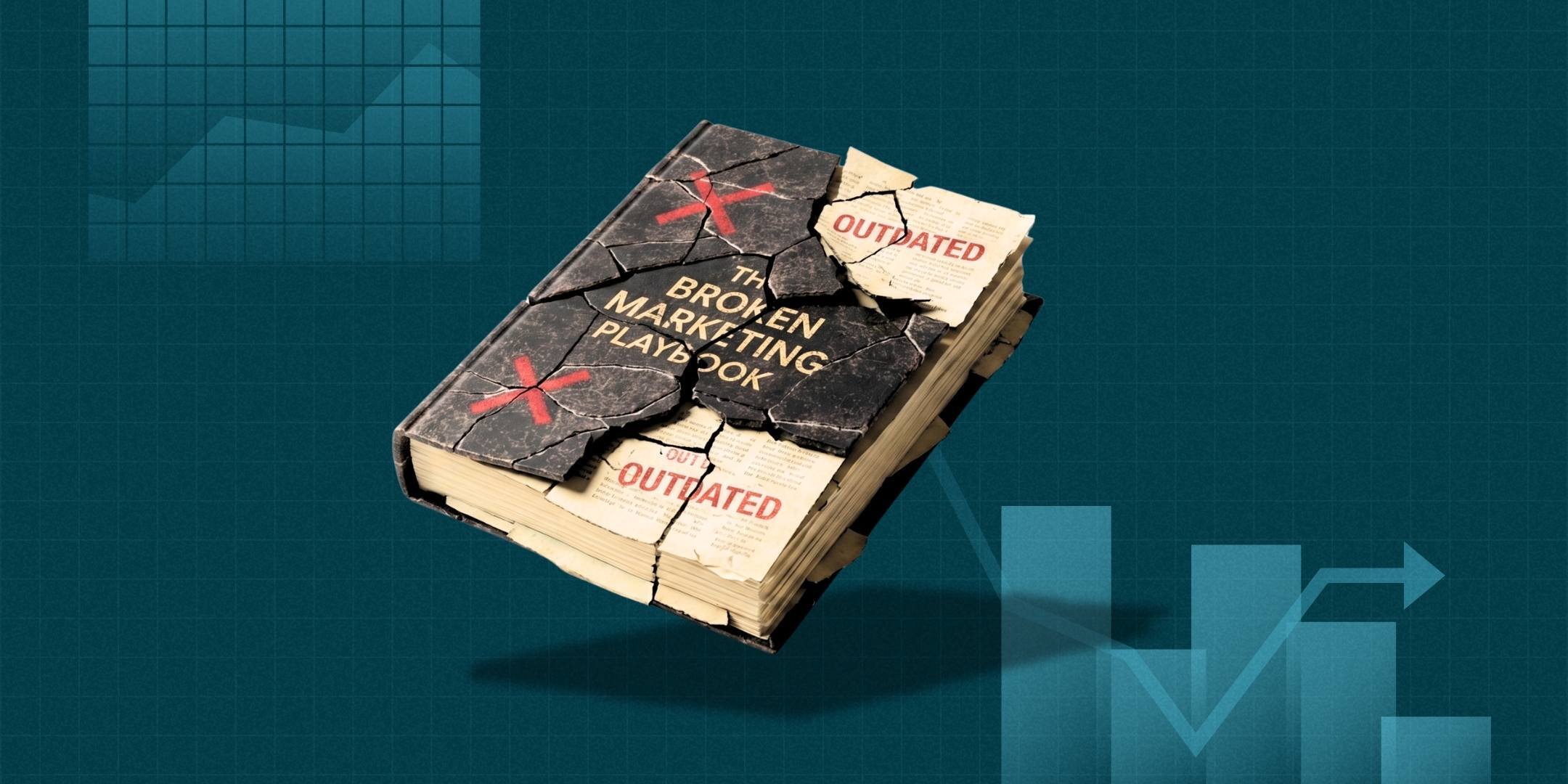
Learn why single-message campaigns, CAC obsession, and last-click metrics fail in today’s AI-driven media—and how message, funnel & signal diversity...

Facebook is not failing marketers. Rather, marketer’s agencies are failing to help them understand how to use—and measure—Facebook effectively.

Watch BCM Principal Stuart Meyler discuss the benefits of moving away from proprietary technology, and how the industry is shifting.