9 min read

At BCM, we define content engineering as a pre-designed system of production stages and human checkpoints that every piece of content passes through before it publishes. As AI takes on more of the drafting, that system is what keeps quality intact while volume goes up.
Last year Deloitte Australia delivered an A$440,000 report to the Australian government that had been drafted in part with GPT-4o. A University of Sydney researcher found it full of fabricated references, including a quote attributed to a federal court judgment that the judgment doesn't contain. Deloitte reissued the report with an AI disclosure and refunded part of the fee.
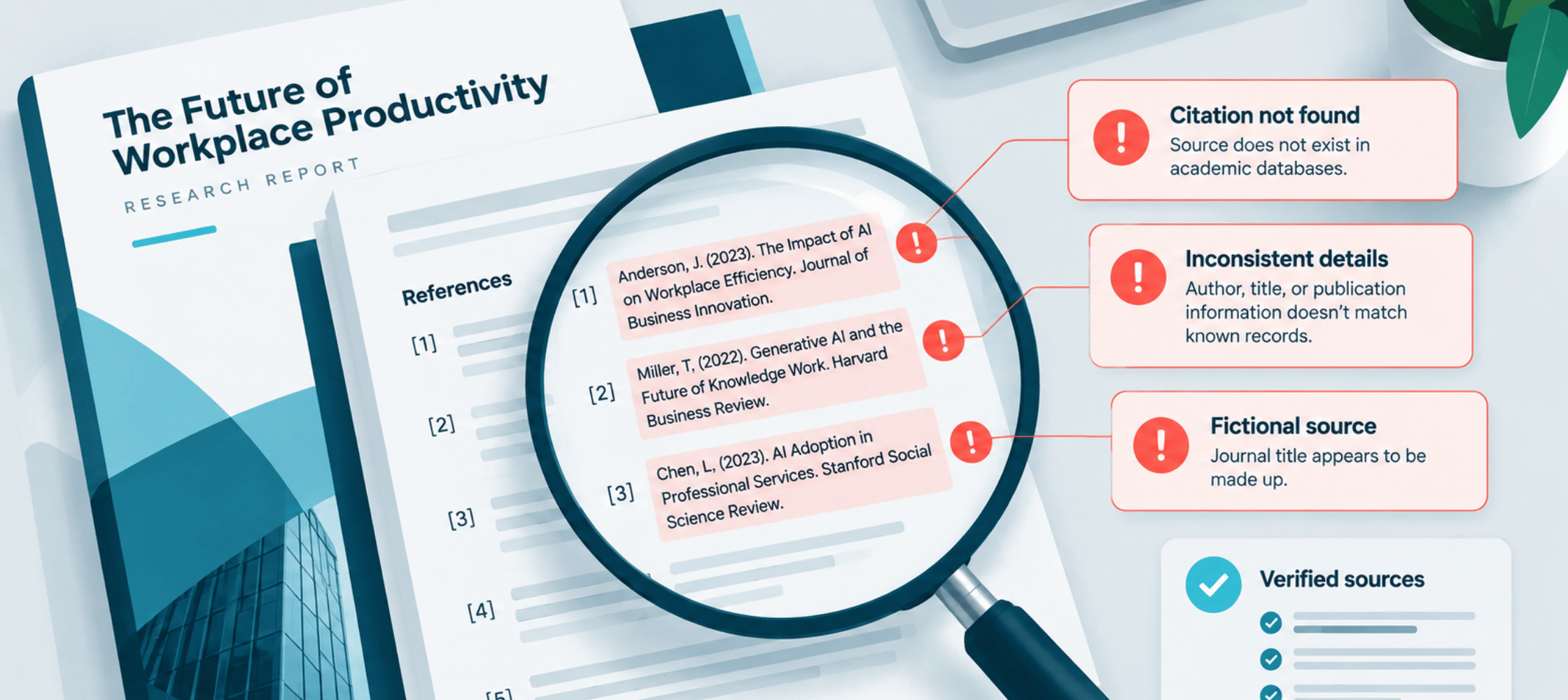
GPT-4o was years ahead of the models publishers were experimenting with in 2022, and the failure happened anyway, at a Big Four firm with every resource to catch it. What was missing was a checkpoint: someone whose job was to trace every citation to its source before the report shipped. From what we see, the brands winning in AI search built that human review and approval layer first, then scaled once they trusted the output.
What Content Engineering Actually Means When AI Is in Use
In practice, content engineering means designing the systems that produce content and make it discoverable, to people and to AI, rather than producing individual pieces by hand. The division of labor is straightforward: a strategist chooses topics, a writer produces an article, and a content engineer builds the pipeline that connects research, drafting, review, structure, and publication into one repeatable process.
The role predates generative AI. It emerged as a bridge between content teams and technical departments, organizing content's shape and structure through models, metadata, taxonomy, and schema markup, often using vocabularies like schema.org so machines can interpret and connect concepts. What's changed is the center of gravity. I reviewed dozens of US job listings for content development roles on LinkedIn, and where they used to primarily require SEO skills, that has changed. About 80% now ask for content writing aimed at AI search visibility, and around 40% want proficiency with AI workflows. These roles are also posting higher salaries than they used to. My own findings point the same direction as Moz's analysis of 1,543 SEO job listings, which found nearly half requiring AI search fluency and the biggest premiums attached to senior roles that can build cross-functional AI workflows. The market is looking for systems builders who can write, not writers who happen to use AI.
If the content strategist is content's CEO, owning who, what, when, where, and why, the engineer is its CTO, owning how. The two need each other. Engineering without strategy just scales the wrong things faster.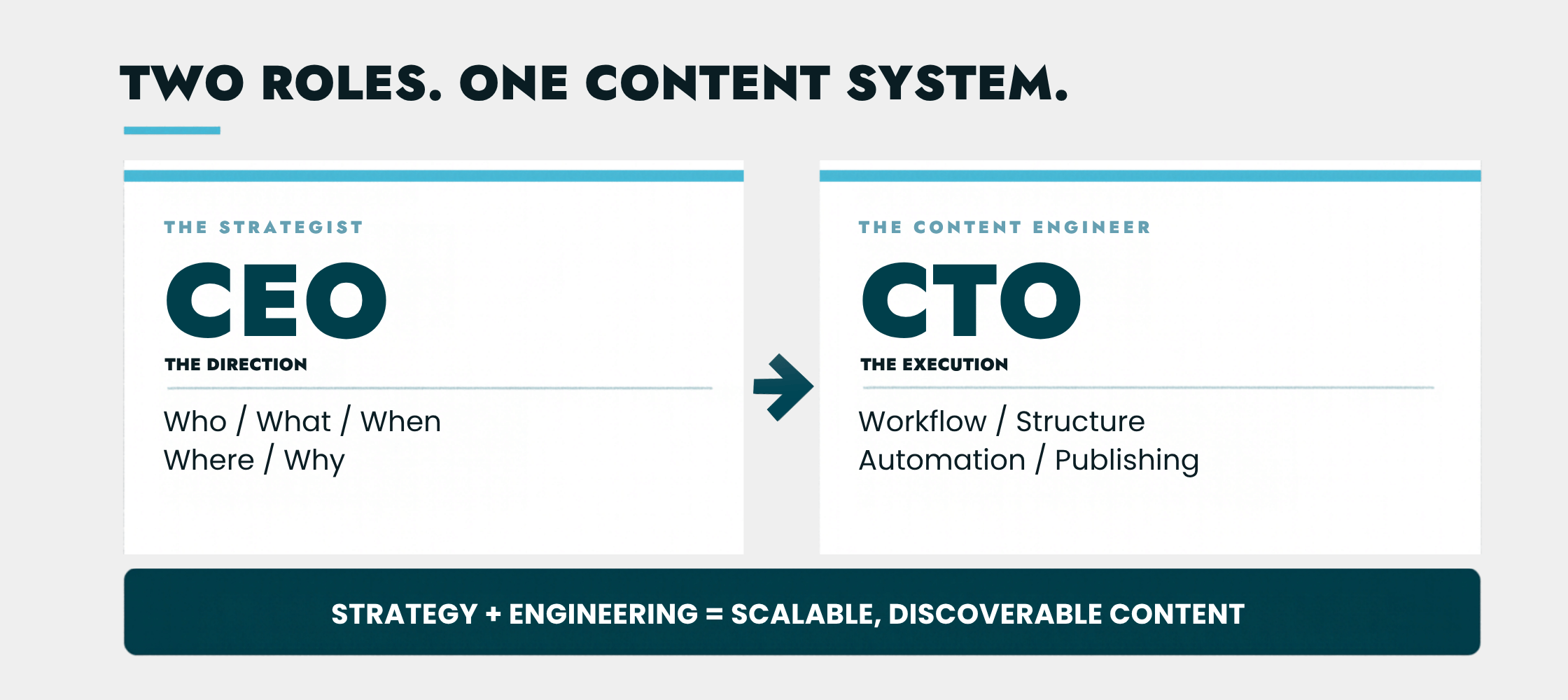
Where AI Genuinely Earns Its Keep in the Content Workflow
AI earns its place in research, structure, and drafting, the stages where volume and pattern recognition matter more than judgment. When a system is connected to live SEO data, it retrieves real keyword metrics, parent topics, and long-tail variations instead of making them up. It can cluster audience questions into themes, pull a SERP overview to determine dominant intent, and extract topics, headings, and content gaps from top-ranking competitors. That's days of analyst work compressed into a pipeline stage.
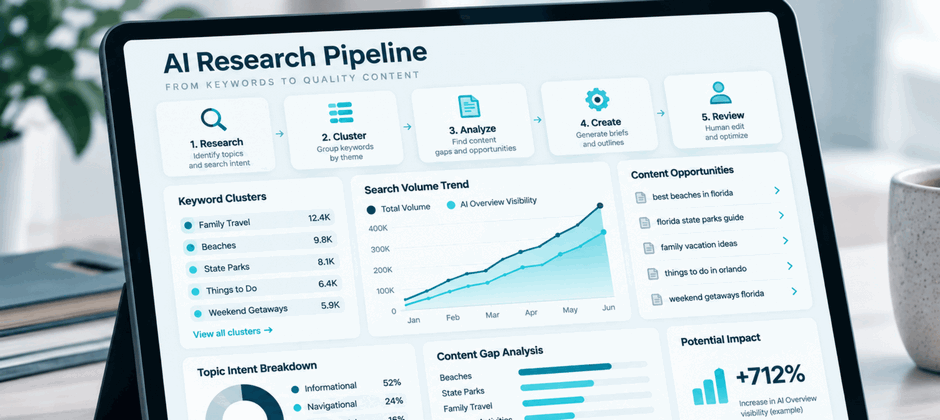
VentasAI | Content, our content engineering process at BCM, runs on a stack of skill files, one per stage, from keyword research through gap analysis to outlining, and each one holds a documented process, examples to emulate, and output formatting rules. Skill files can bloat, so every few months I go through and cut them back to whatever is actually load-bearing, and if a skill hasn't measurably changed an output, it goes.
AI also carries the maintenance load most teams neglect. Pipelines can pull traffic, ranking, and AI citation data from Search Console and analytics to flag decaying pages, so each publishing cycle informs the next. Repurposing works the same way: one published article becomes three to five social posts following codified voice and hook rules, which hands creative time back to the team.
AI lifts the production ceiling. It doesn't lower the quality bar unless you let it.
The Human-in-the-Loop Checkpoints You Can't Skip
Governance is what stops bad work from shipping, and it rests on a handful of checkpoints: fact-checking, citation verification, brand-voice enforcement, and structured human review. Skip any one and you might as well let a sixth grader write your content, because the output is not going to be credible or good.
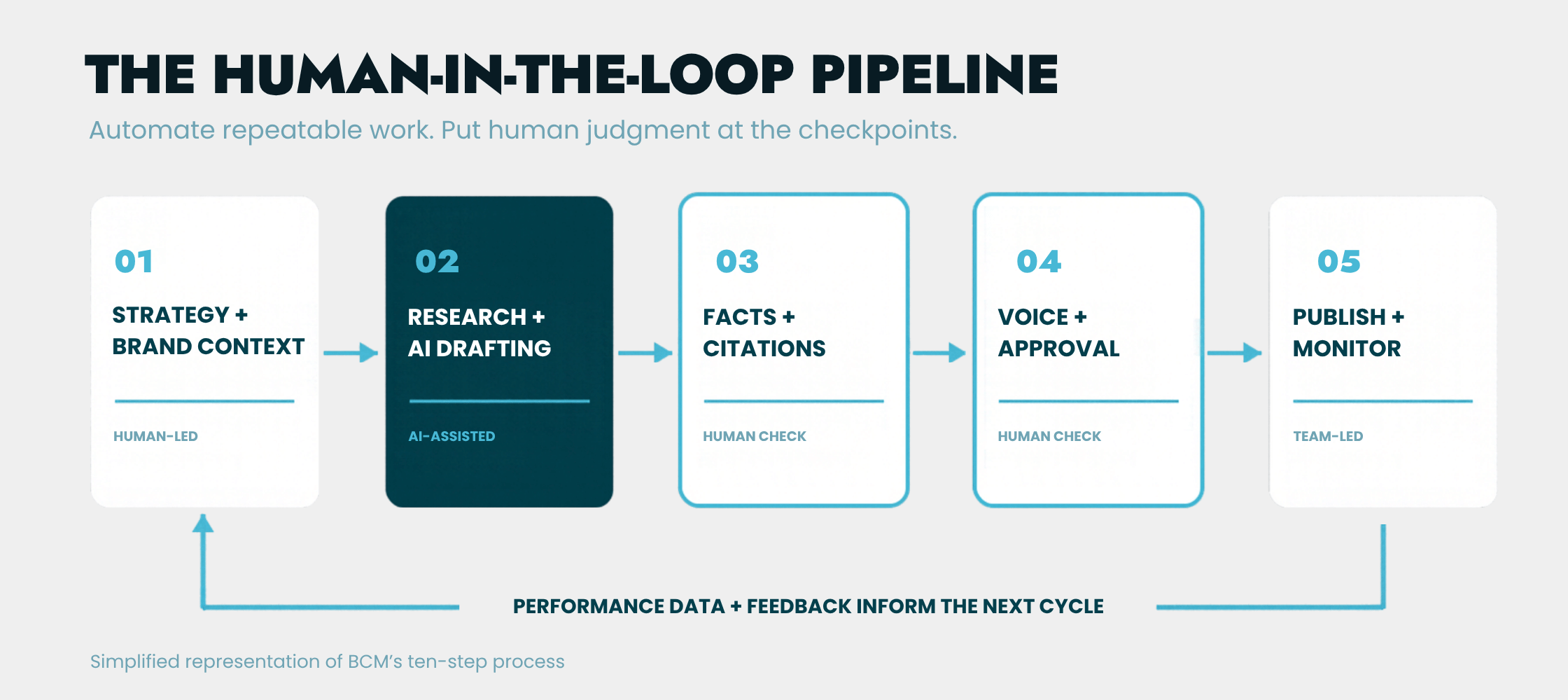
VentasAI | Content is a ten-step human-in-the-loop workflow. Humans set the strategy and context up front, review verified facts before drafting, and apply editorial judgment before anything is published, and then there's another round of review with you, the client. The process is like having a new and very fast copywriter on your creative team, and since they're new, you need to be hands-on as the chief editor. You'll do some work. You'll still get a great output faster than before. Oh and they learn. They learn quickly and the process gets more efficient with those
learnings, because editor and client feedback all gets rolled into the next output for consideration.
On a current project, the first piece came back from the client with 15 to 20 comments, and our own account team started asking fair questions about whether the process was worth it. The client's subject matter experts made their edits. Those edits went back into the workflow, and the pieces since then have come back with fewer than five comments each. Same project, same reviewers.
If you've ever run an algorithmic media platform, this is familiar. The opening stretch looks inefficient because the system is testing audiences, testing copy, testing images, and then it learns and the efficiency shows up and the goals get hit. Content development works the same way, and it's better still when the machine can predict those efficiencies before a penny gets spent, which is what we built VentasAI | Predict to do.
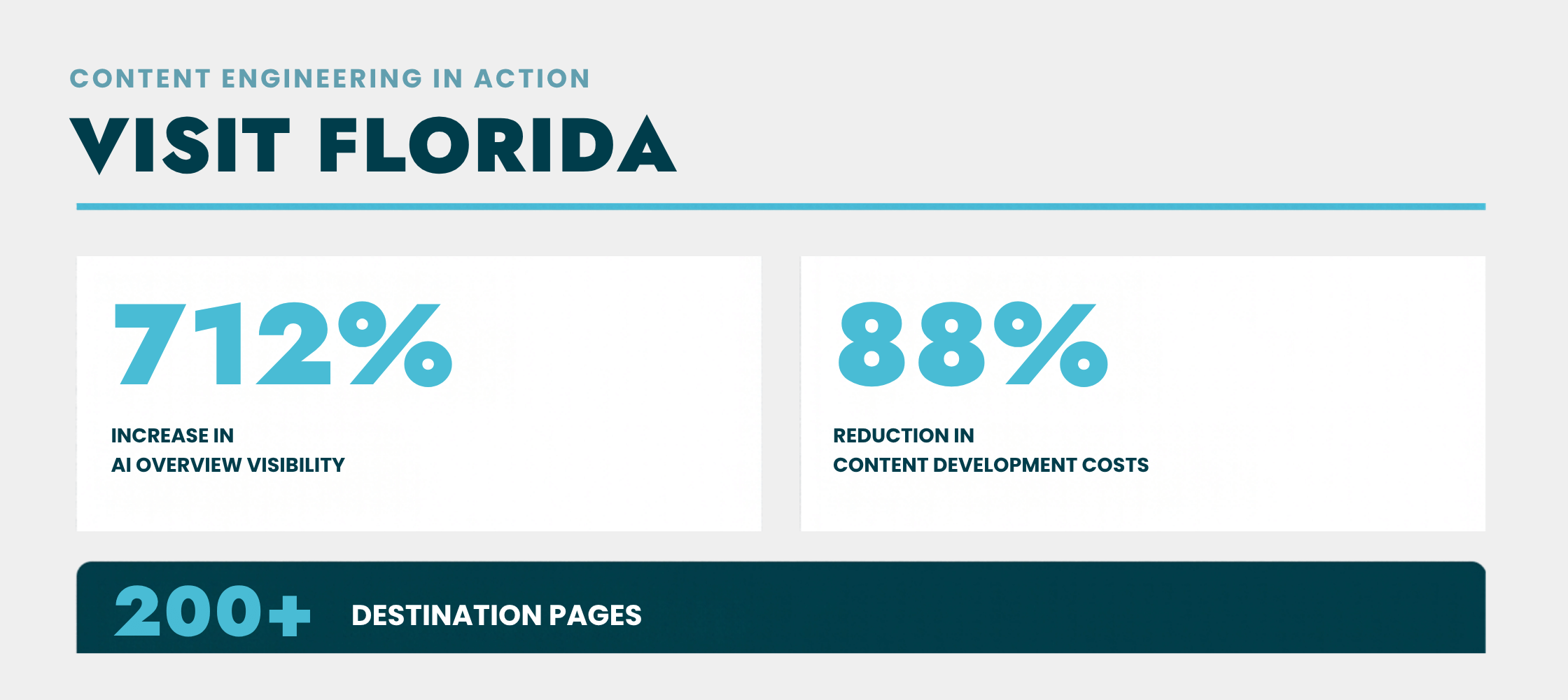
This architecture is why our AI-powered workflow for VISIT FLORIDA drove a 712% increase in AI Overview visibility across 200+ destination pages. Content development costs dropped 88% over the same stretch (case study). That work made BCM a co-finalist alongside Adobe for the 2026 Digiday Content Marketing Award for Best Use of AI in Content Production.
The non-negotiable checkpoints, in order of importance:
- Context before production. The engineer's first duty is embedding brand positioning, tone, and audience insight into every workflow before anything runs. Flawed input context breaks all downstream output. This is generally covered in a brief, and the smallest details matter when you're dealing with an LLM.
- Explicit claim rules. Every factual assertion needs a verified source. No source, no claim.
- Assigned review ownership. A named human signs off on claims, voice, and compliance. Content intersects product, analytics, design, SEO, and legal, and diffuse accountability means no accountability.
- Refresh routines. Published content decays, and someone owns the cycle that catches it.
What Happens When Brands Skip the Human Layer
CNET is the older case, and the one with a recovery arc. In late 2022 the site published 77 finance explainers written with an in-house AI engine, as many as 12 in a single day, under the byline "CNET Money Staff." Readers weren't told AI was involved unless they opened a dropdown on the author page, and it only came to light because Futurism went looking. One explainer told readers that a $10,000 savings account earning 3% compounding annually would generate $10,300 in interest in a single year. Whoops.
That happened at a publisher with professional editors on staff. After Futurism flagged the error, CNET issued a correction covering five separate problems in that one article: the $10,300 claim, a second example built on the same bad math, a wrong statement about how often one-year CD accounts compound, a miscalculated car loan, and a conflation of APR and APY that produced bad advice.
Then came the audit. CNET corrected 41 of the 77 AI-assisted stories, more than half, some substantially. At least one correction noted that phrases had been replaced because they weren't entirely original, which is a polite way to describe a plagiarism problem. Nearly all the AI pieces eventually carried an editors' note.
The structural lesson matters more than the errors. Outsourcing writing to AI at volume shifts the entire quality burden onto editors reviewing text that sounds authoritative whether or not it's correct, and at that volume, missed errors become close to inevitable. A model writes with equal confidence whether it's right or wrong, which makes review harder than editing a human writer who at least signals when they're unsure.
Google's position raises the stakes further. Automation and AI generation aren't inherently spam, but Google states that using them primarily to manipulate rankings violates its spam policies, and that generating separate pages for every query variation to influence rankings or AI answers breaks its scaled content abuse policy. More pages don't raise quality or relevance. They raise volume. Google also recommends that publishers automatically generating content describe that process for their audience, and CNET's dropdown byline is the counterexample.
CNET didn't stop using AI for content development. About five months after the blowup they published an actual AI policy, named the in-house tool (RAMP, for Responsible AI Machine Partner), committed to never letting it write a full story, and started disclosing when AI-generated text made it into a piece. They also went back and put an editor's note on all the old ones.
What a Content Engineering Pipeline Looks Like in Practice
A website content strategy built for AI search treats content as a continuous pipeline. Research produces briefs, briefs produce drafts, drafts go to review, and performance data feeds the next research cycle, with handoffs automated where feasible and reviewed by people where judgment counts.
The platform market is following. A $40M Series B went into a content engineering platform for AI search in late 2025, and the category now has real venture money behind it, with tooling that combines SEO performance, AI visibility, and on-site analytics against native CMS integrations. Buy or build, the architecture is the same, and the checkpoints are what determine whether it works.
Two practical notes if you're starting out. You don't need a full content engineering function on day one, so identify your existing systems thinker and have that one person package the team's best workflows as reusable skills, starting with a single costly repetitive process. And point the pipeline at how AI systems actually retrieve and cite content, which is a different discipline from classic SEO. Our guide to content optimization for AI search covers how to make content discoverable, understandable, and citable by systems that generate answers instead of listing links.
Key Takeaways: Making AI-Powered Content Creation Actually Work
The dividing line in AI-powered content creation isn't tooling. It's discipline. Actions worth taking this quarter:
- Build systems, not articles. Split your editorial process into automatable stages and codify each one in reusable, continuously pruned skill files.
- Install governance before scale. Fact-checking, citation verification, voice enforcement, and named human reviewers are prerequisites, not enhancements.
- Front-load context. Embed positioning, tone, and audience insight into every workflow before production, because bad inputs guarantee bad outputs.
- Point production at restraint. The team that could publish tens of thousands of articles but deliberately maintains a focused evergreen library will outperform the one that floods its own domain.
- Close the loop. Wire performance and citation data back into research so every cycle is smarter than the last.
- Disclose and verify. CNET's audit-after-publication model is the failure mode. Verify before publishing, and describe your process to your audience.
Frequently Asked Questions
What is content engineering in marketing?
Content engineering is the discipline of designing the systems, structures, and workflows that produce content and make it discoverable to both people and AI. It covers content modeling, metadata, taxonomy, schema markup, and increasingly AI-assisted pipeline design, implemented through CMS platforms, APIs, and automation tooling. Its economic purpose is raising return on content investment through reuse and efficiency.
How is content engineering different from content strategy?
Strategy owns the who, what, when, where, and why of content. Engineering owns the how. The strategist functions as content's CEO, planning creation, publication, and governance, while the engineer acts as its CTO, building the assets, platforms, and publication systems that execute the plan. Neither succeeds without the other.
What does human-in-the-loop mean in AI content creation?
Human-in-the-loop means people review and approve AI output at defined checkpoints rather than letting automation publish unsupervised. In a mature pipeline, handoffs are automated where feasible and reviewed by people where judgment counts, on claims, voice, and compliance. At minimum you need one named owner per piece with explicit accountability, because the number of reviewers matters less than the assignment. CNET had editors. The review burden at 12 articles a day exceeded what accurate editing allows.
Can AI-generated content rank well without human editing?
Sure, for a while. Then the accuracy and policy risk catches up with you. CNET's editors audited their own published AI output and corrected 41 of 77 stories after the fact, and Google's spam policies target content generated primarily to manipulate rankings. Human editing is what converts an AI draft into content that sustains visibility.
What tasks should humans always own in an AI content workflow?
Humans own strategy, claim verification, brand-voice sign-off, and final publication approval. The content engineer's first duty is embedding positioning, tone, and audience insight before production begins, and a named reviewer checks claims and compliance on every piece, because content intersects legal, product, and analytics.
How do you fact-check AI-generated website content at scale?
You build explicit claim rules into the pipeline instead of asking editors to catch errors after drafting. Every factual assertion should trace to a verified source before it enters a draft, with citation verification as a formal governance checkpoint. CNET demonstrates the alternative, where reviewing authoritative-sounding text at volume makes missed errors close to inevitable.
Does automated content creation hurt brand voice?
Only when teams skip the codification step. Well-built pipelines encode voice through reusable skills, prompts, and internal knowledge bases holding brand guidelines, positioning frameworks, and proprietary research, so the system draws on company knowledge rather than generic training data. Voice enforcement then becomes a governance checkpoint before anything publishes.
What's the risk of publishing fully automated content?
Factual errors at scale, Google policy violations, and lasting credibility damage. CNET paused its AI tool after audits found corrections were needed on more than half of its 77 AI-assisted stories, and Google's scaled content abuse policy targets mass-produced pages built to influence rankings or AI answers.
Was this article written with the processes described above?
Yes. VentasAI | Content handled keyword research, the competitive gap analysis, brief development, and the first draft structure. Every factual claim in this piece was traced to a primary source before it went into the draft, which is how the CNET numbers got corrected twice during editing, including one error in an early version of this article. A human wrote the argument, cut roughly a third of the draft, and signed off on it.
If we'd published the first pass unedited, you would not be reading this sentence, because we'd have taken the post down.